
This explanation about Equalizers is linked to Luc Armant's Report "What we want" : Check it here !
A practical solution to the ballast problem:
To compensate for the performance difference between paragliding wing sizes an artificial parasitic drag device in the form of a pair of foam tubes is installed on the center rear-rise lines. These Size Equalizers can be easily adjusted in length according to a simple formula, with their simple shape provide a well-known amount of drag and compliance can practically be verified in the field.
It is proposed that Size Equalizer become mandatory in CAT1 competitions to remove one of the incentives for "ballasting up" to a larger size to be competitive.
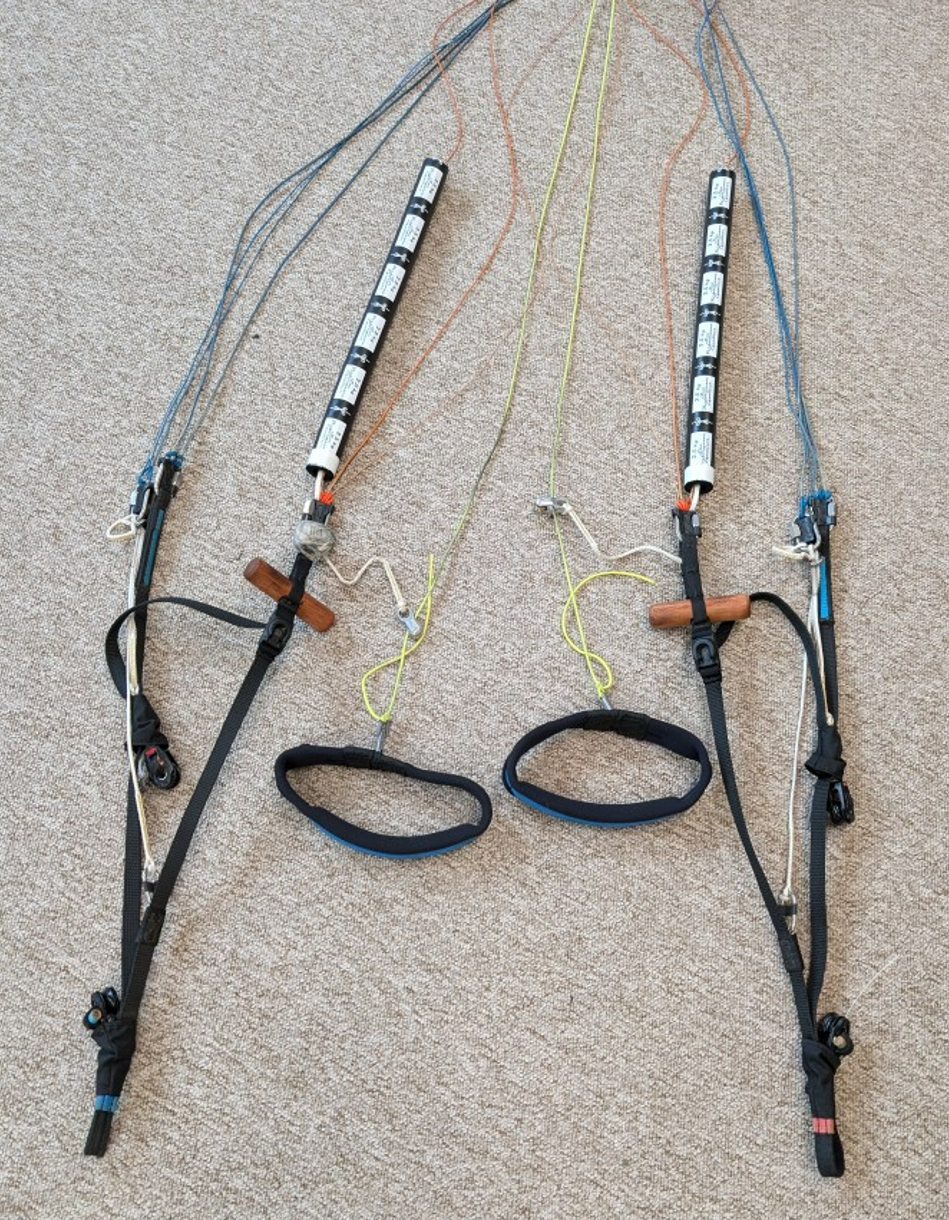
Figure 1: A pair of Equalizers mounted on an Enzo3 S weight_range_max = 105 kg)
Specifications
Size Equalizers are mandatory for all pilots flying a wing with a certified maximum weight range above 90 kg according to the following specification:
- weight_range_max is the certified maximum weight range of the paragliding wing in kg (also known as Maximum Take Off Weight (MTOW), maximum weight in flight or maximum total weight in flight)
- Pilots flying a wing with weight_range_max above weight_range_threshold are required to install equalizers
- weight_range_threshold is 90 kg
- rounded_weight_range_max is weight_range_max rounded up to the next multiple of 2.5 kg
- tube_length is the length of size equalizer tube installed on each the left and right rear-riser in millimeter [mm]
- tube_length = (rounded_weight_range_max - weight_threshold) * 22
The size equalizer tube diameter is 25 mm. Printed graduations on the size equalizer tubes allow for accurate cutting to size and practical in-the-filed checks. Each graduated segment of tube is 55 mm in length, equivalent to a 2.5 kg step in rounded_weight_range_max (2.5 * 22 mm = 55 mm).
Example:
weight_range_max for an Enzo3 S is 105 kg. rounded_weight_range_max is thus also 105 kg. tube_length will then be 330 mm calculated as (105 - 90) * 22 mm = 330 mm. Alternatively the number of graduated segments can be calculated as (105 - 90) / 2.5 = 6. Figure 1 above shows equalizers tubes according to this specification installed on the center rear-riser lines of an Enzo 3 S.

Table of examples
Calculated polars on Enzo 3 of various sizes without and with size equalizers:

Without Size Equalizers
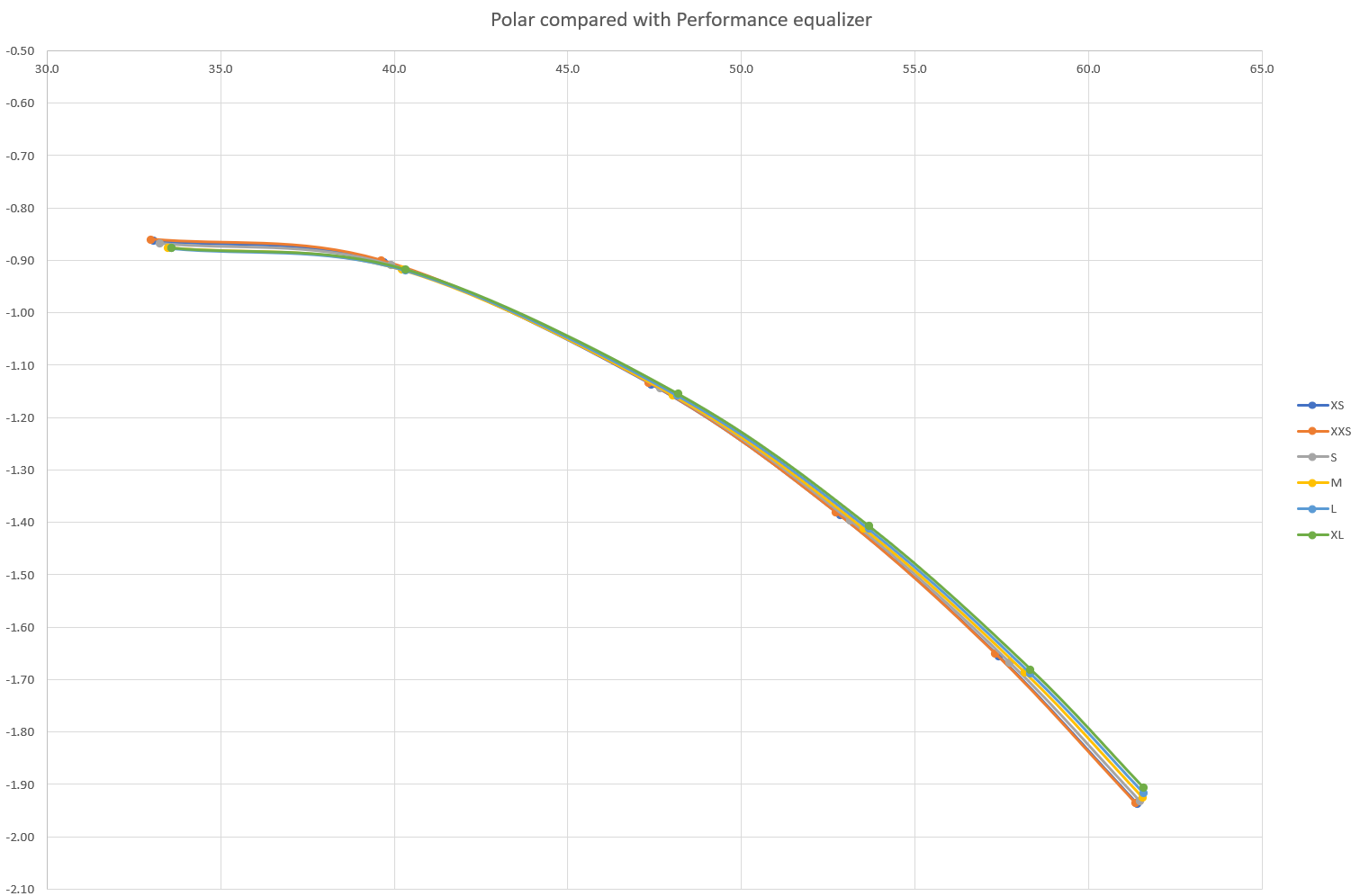
With Size Equalizer
Notes about theses polars:
- The line drag is anticipated as optimized for each size with the expectation that size-specific load-testing is likely to happen on the next generation competition wings should Size Equalizer be implemented (currently load-testing is performed on the largest size only and the same line diameters are used across all wing sizes irrespective of the lower load on smaller wings).
- The increased parasitic drag of pilot and harness for a relatively heavier pilot on a larger wing is realistically taken into account using an average representation of the pilot's arms, neck and helmet drag.
- The drag coefficient for the size equalizer tubes is Cd = 1.1 (Check this chart for more reference)
- The performance at full speed is not fully compensated for because the performance at low speed and in thermalling is not in favor of the larger sizes. The intention being that the overall performances including thermalling are similar across sizes. It would be possible to size the Equalizer to a point where larger sizes would globally perform less than smaller sizes, but that’s not the goal.
Frequently Asked Question
In practice pilots do worry about it. While the difference in performance may look small, most pilots appear to not want to have this disadvantage against them.
Competition is firstly about relative performance. This frustration should be more than compensated for by the pleasure of competing on fair performance ground against all fellow pilots, including those on smaller wing sizes, and by the fact that the winning pilots did so on the basis of their merit and skill. The small loss of performance advantage for the larger sizes (so as to equalize the field with the smaller size wings) is still good enough to continue setting the same sort of task as is the case today while absolute performance for XC flying remains unaffected (the equalizer can easily be added/removed and would only be used in competition).
Equalizing by means of extra parasitic drag by varying harness protector sizes or lines diameter or any other piece of equipment is not practically manageable in a competition environment as it would be rather difficult to reliably evaluate and verify this across a variety of manufacturers. In contrast, the size equalizer proposal suggests a dedicated device whose exclusive function is to add a precisely quantifiable amount of parasitic drag based on a simple shape and which can be practically managed in a competition environment. Equalize reduce the performance advantage of larger wings without changing any other piece of equipment.
These Equalizers are size equalizers, designed to compensate for the performance variation due to physical scale effect between sizes and nothing else. Compensating for differences between brands or models would be another subject. A much more complicated subject. Amongst other huge issues, this would kill any incentive for manufacturers to improve equipment.
No, these equalizers compensate for the average physical size effect and anticipated in the calculation that bigger size pilots have larger parasitic drag. Other aspects, like a pilot's unique geometry, are not taken into account. For instance, if a pilot has bigger arms than another of the same weight, this is not compensated for by size equalizers. Note however, that this has never been compensated for anyway. It is another minor subject that has not been driving our sport to serious issues.
Pilots are given a pair of equalizers corresponding to their wing size at registration. Organizers or pilots can trivially check other pilot’s number of graduations on equalizers. A pilot flying without equalizers will be immediately notices by other pilots. Organizers can easily perform a check on take-off and/or landing for any pilot.
Not at all. If the implementation is successful, the incentive for ballasting up in order to fly with a bigger size wing is much reduced. Traveling with and carrying heavy bags, taking risks while taking-off, flying and landing with the extra weight will provide great counter incentive to "ballasting up" when size equalizers are used.
If the implementation is successful, we can expect that after one season pilots will start to buy smaller size wings and carry less ballast. Also it is expected that manufacturers will optimize and improve small size competition gliders as they would now be able to see the necessary return on investment and with a realistic chance to have small size wing winning competition. Also, it is expected that manufacturers will design lighter competition harnesses which would be more desirable by pilots.
If the implementation is successful, it’s realistic to expect that after a few seasons, a typical competition pilot’s bag would weigh about 15-20 kg, instead of the 35-40 kg or even more today.
If the implementation is successful, it’s realistic to expect that after a few seasons, a typical competition pilot’s bag would weigh about 15-20 kg, instead of the 35-40 kg or even more today.
That is another alternative solution but there are some serious downsides. Having multiple classes on a very small sport like ours means more champions titles, which assigns less value to each one. Having only a few classes would still maintain a ballast issue within each class. The overall title would likely remain the most prestigious and a strong incentive for ballasting up would remain.
There are:
- Multiple Radius Turnpoints (MRT) (larger turn-point radii for smaller sizes).
- Formula-based compensation on points after the task.
In both cases, the main disadvantage is that the tactical aspect of the race changes, especially in high level competition. In high level competition, the performance is much more influenced by group flying tactic than by the difference in performances between sizes. This sort of solution could only work well in case of an elapsed time task with pilots flying alone.
- Another alternative is to simply prohibit the use of ballast.
This was the case before and it proved to not work well in practice. It was a race to increase body weight. Other sports have shown that it’s not a good path. There were many cheaters while checking was difficult.
Equalizers have been tested during collapses, stall or spin and they have shown to not affect the recovery behavior of the wing. They are placed near the center of gravity of the wing-pilot system so they do not affect its equilibrium in rotation and do not affect air speed equilibrium. Adding Equalizers will not make the aircraft slower, it just increases sink rate slightly.
A couple of notes on the idea of "taking a wing out of certification": Pilots fly their wings with harnesses different from the ones used in certification, this will surely affect the wings behavior. When adding line loops during trimming their strength is affected. Collapses "in the wild" are different from the collapses induced during certification by the test pilots according to the test protocol. Does pulling some break when the test pilot didn't "take a wing out of certification"? Please check the norm EN 926-2 for more reference.
A couple of notes on the idea of "taking a wing out of certification": Pilots fly their wings with harnesses different from the ones used in certification, this will surely affect the wings behavior. When adding line loops during trimming their strength is affected. Collapses "in the wild" are different from the collapses induced during certification by the test pilots according to the test protocol. Does pulling some break when the test pilot didn't "take a wing out of certification"? Please check the norm EN 926-2 for more reference.
Main Strength
- Inclusive system. One race with equalized chance for all glider sizes.
- Racing spirit and philosophy remain intact. Tactics, gaggle flying, leading points work as before, just more fairness and less incentive to ballast up.
- Heavily backed by performance data.
Main Critics
- Logistics. Organisers must provide and check the equalizers length. Pilots must install them cleanly.
- No immediate change for the lightest pilots who still need/want to ballast up (those below 90 kg).
- No compensation for handling or other physical difference (tall, big arms).
- Lack of real world testing. Legality and safety concerns.