
This explanation of weight checks is not linked to the union's "What we want" discussion but is rather coming from the CIVL Bureau and PWCA Committee.
A practical solution to ballast:
Define a ballast limit and enforce it with weight checks at takeoff and landings.

CIVL President on 10/17/25
"The genral feeling in the Bureau is that we need to reinstate the ballast limitation [...] "
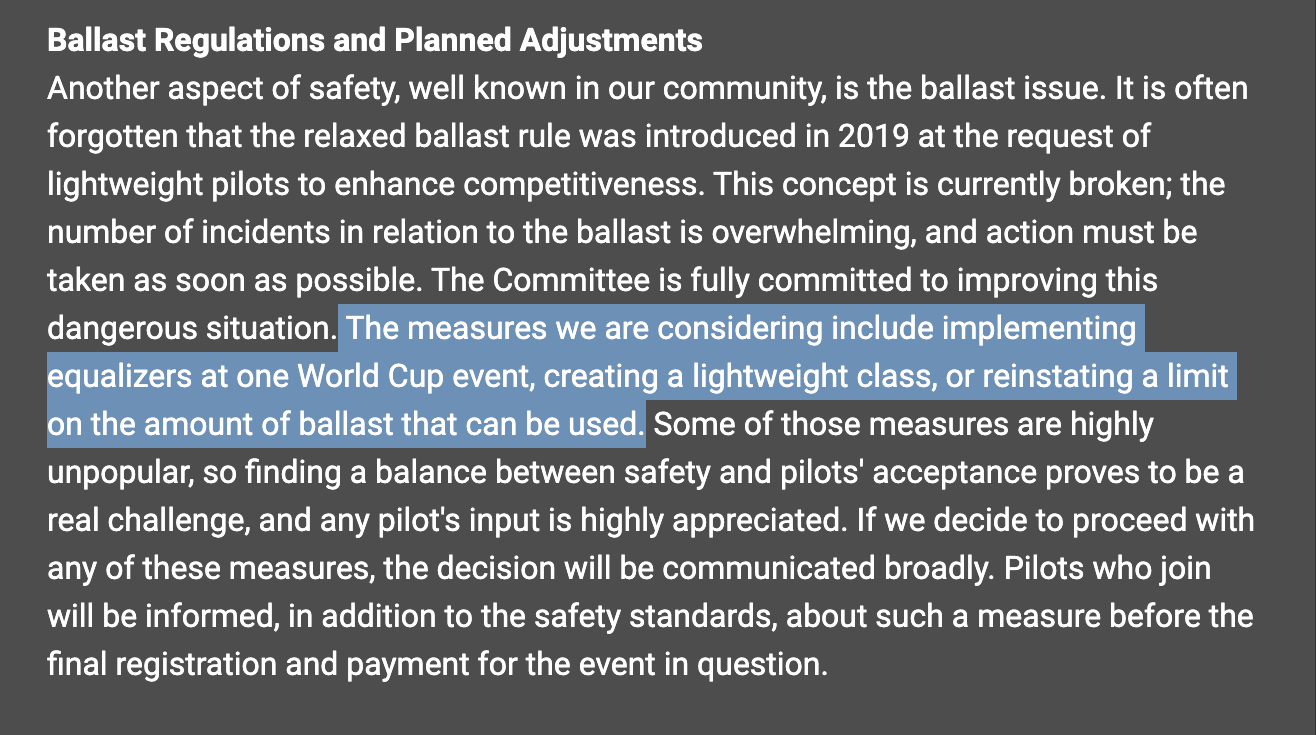
PWCA Newsletter
"[...] Reinstating a limit on the amount of ballast that can be used"
Specifications
8.5.4 Ballast Pilots must comply with the weight limitations set by the glider airworthiness standards. FAI Sporting Code, Section 7A - 1st May 2018 33 The pilot’s weight is defined as body weight when dressed in jeans, shirt and underwear. Weight can be measured at take-off or landing at the request of the organisers. Pilots may carry jettisonable ballast only in the form of fine sand or water. A pilot must avoid dropping ballast at any time or in a manner likely to affect other competing gliders or third parties. The total weight, including all flight equipment and glider, must not exceed 33 kilograms in addition to the pilot’s weight. As an exception, all pilots are allowed to ballast up to a total weight of 95 kg including all flight equipment and glider. It is the pilot’s responsibility to ensure they have the competence and fitness to launch unaided at this total weight. Sporting Code section S7 9.14 and 9.15 apply.
17.8 Ballast A competing glider may carry jetisonable ballast only in the form of fine sand or water. A competitor must avoid dropping ballast at any time or in a manner likely to affect other competing gliders or third parties. The total ballast, including all flight equipment and the glider, must not exceed 33kg in addition to the pilot's weight. The pilot's weight is defined as body weight when dressed in jeans, shirt and underwear.
PWCA Rules 2005
Ballast Rule Reintroduced !
Ballast Rule Reintroduced !
Such recent declarations intend to be a fallback to adress a ballast issue for which institutions don't seem to find a solution.
This approach was abandoned before because it encouraged ...
- A bad diet to gain weight
- Drinking/eating as much as possible directly prior to initial weight checks
- Hiding additional weight on ones body for the initial weight check
- The use of steroids to gain weight
- Getting rid of ballast before a landing check
- Penalizing pilots at "random" with landing check
Clear contraindications
- Light pilots are unable to be competitive: Even small CCC needed and still need over 100 kg.
- The problem isn't really solved: 33 kg equipment is still way too heavy.
- Checks are not practical to enforce broadly: 120 pilots.
- Encouraging cheating and poor ethics.